Why Viewer Retention Drops on Harsh, Unmastered YouTube Voiceovers
On long-form YouTube videos, viewers frequently listen on AirPods, studio headphones, or smart TVs for 15 minutes or longer. When a voiceover track carries raw >12kHz metallic harmonic glare, rigid upper-midrange sibilance between 5kHz and 9kHz, and abrupt digital silence (`<-80 dBFS`) between every sentence, listeners experience subconscious auditory fatigue within the first 60 seconds.
At the same time, YouTube normalizes loud tracks to -14 LUFS integrated loudness while leaving under-compressed dynamic peaks unstable. If your dialogue track swings between -24 dB RMS on quiet transitions and -1 dB peak on sharp plosives, your narration disappears beneath background music beds and sound effects.
Phase Dispersion & Acoustic Humanization: Eliminating >12kHz Metallic Fatigue
Standard parametric EQ cuts in Premiere Pro, DaVinci Resolve, or CapCut cannot resolve metallic high-frequency vocal fatigue because the harshness is caused by deterministic inter-frame phase locking inside the 4kHz–14kHz band rather than a simple frequency boost. Rolling off the high end with a low-pass filter only makes your voiceover sound dull and muddy.
VoxErase solves this at the sample level using Stage 1 & 2 Phase Dispersion and Neural Clock Reconstruction paired with Stage 3 & 4 Acoustic Humanization. Our DSP engine disperses rigid harmonic phase grids, smooths harsh sibilant transients, and applies Warm Class-A analog preamp modeling—giving your narration the effortless, commanding warmth of a treated broadcast booth.
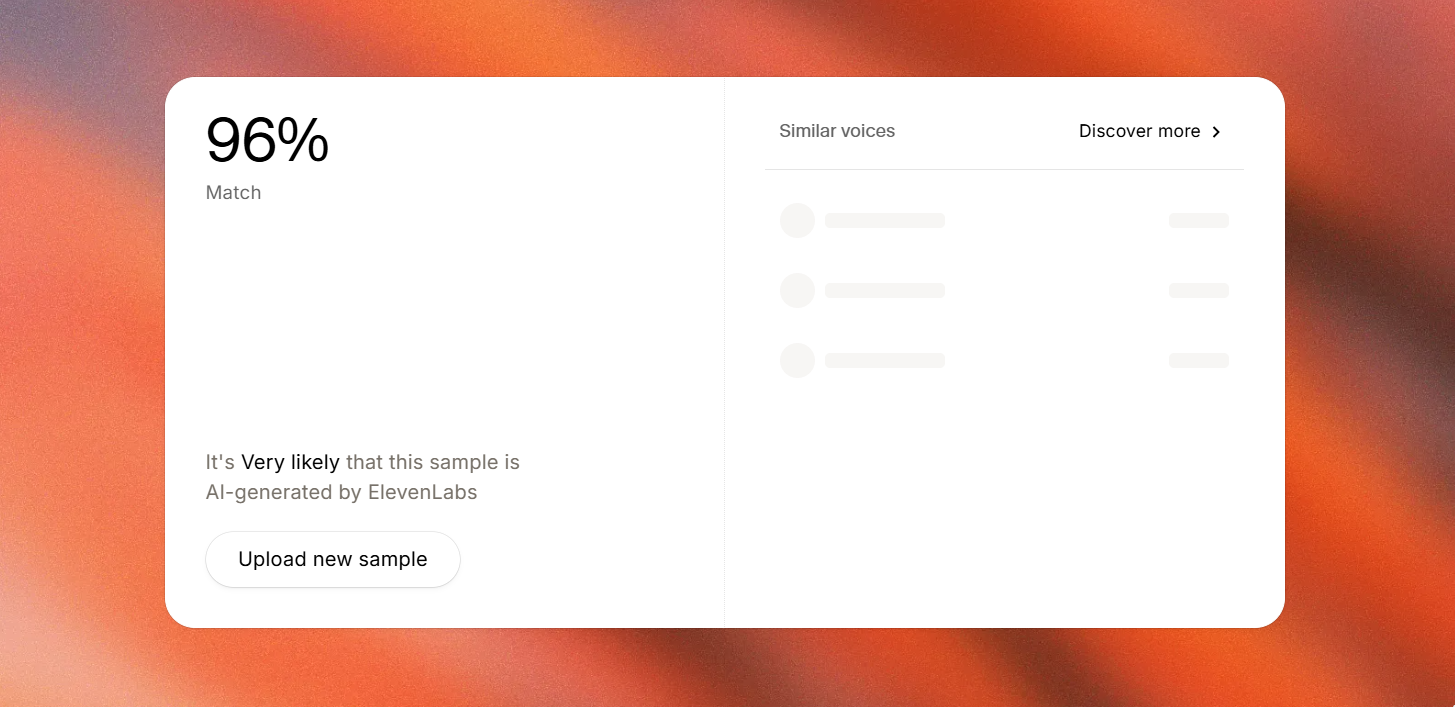
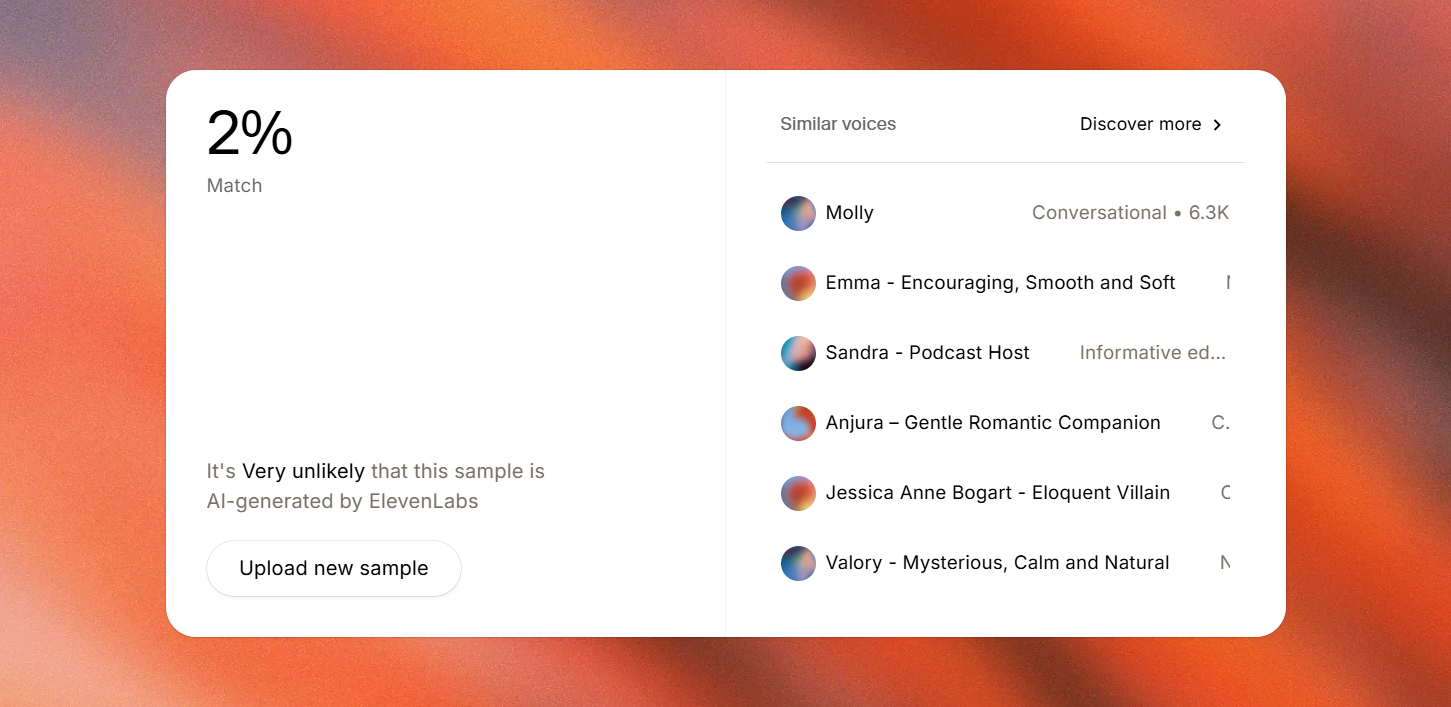
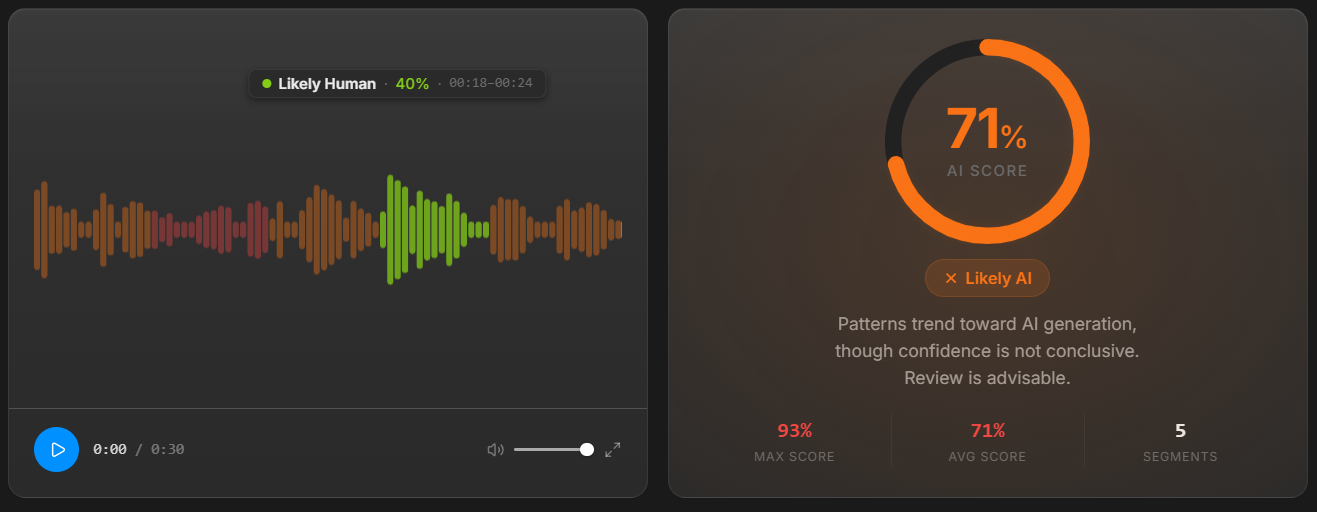
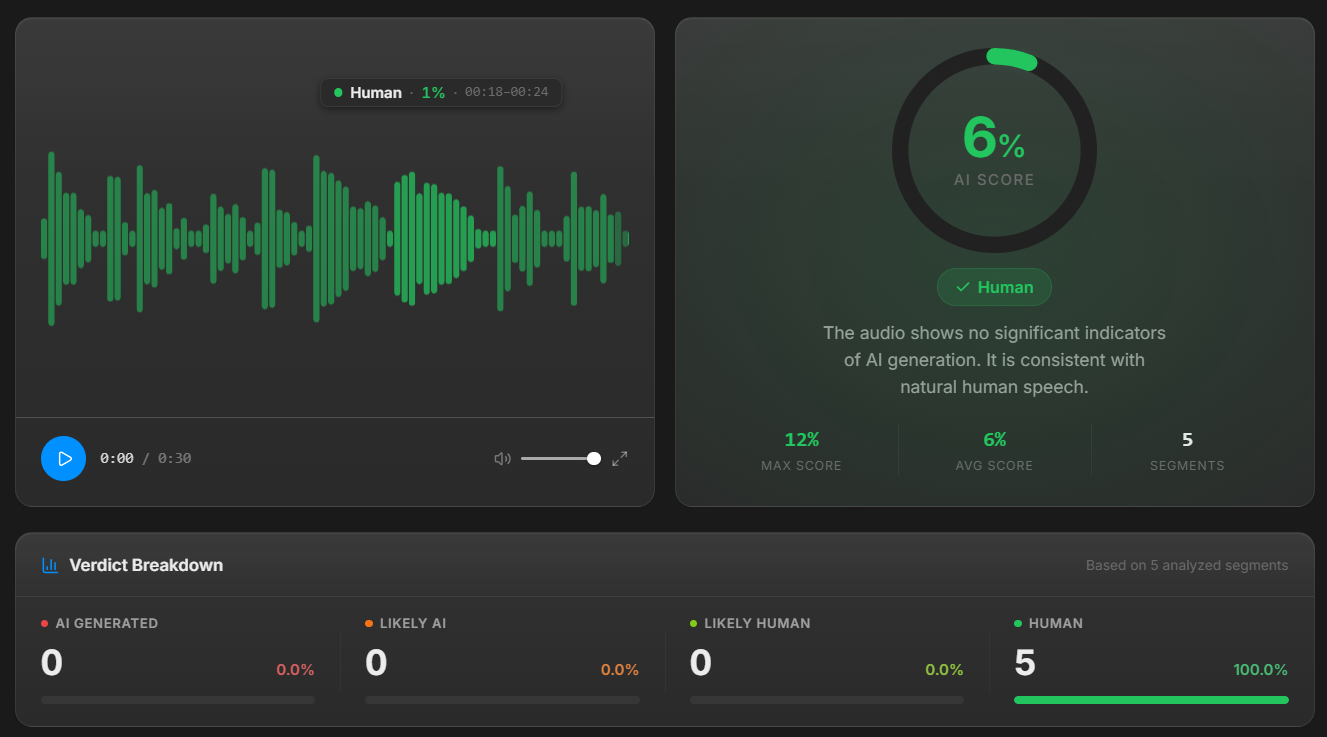
Hear the 96% ➔ 2% Classifier Bypass Proof.
Compare the raw ElevenLabs source against our 6-stage processed master on the Foxwood_01 benchmark, or click any screenshot below to inspect full resolution.
 🔍 Click image to inspect full-resolution screenshot
 🔍 Click image to inspect full-resolution screenshot
 🔍 Click image to inspect full-resolution screenshot
 🔍 Click image to inspect full-resolution screenshot
Stabilizing Broadcast Loudness, Studio Room Air & Clean Container Signatures
To keep dialogue locked comfortably above your background score, VoxErase Stage 5 & 6 Broadcast Mastering stabilizes integrated loudness at -20dB RMS with a safe -3.8dB true-peak ceiling and blends continuous, subtle studio condenser room air across inter-sentence pauses so your voice track never drops into a dead digital vacuum.
Simultaneously, our pipeline sanitizes metadata tags and cleans container signatures (`C2PA`, `JUMBF`, `Lavf`, `LAME3.100`, and `ID3v2`), exporting pristine 16-bit PCM WAV and 192kbps CBR MP3 masters ready to drop directly onto your video editor timeline.
Forensic Breakdown: Platform Detector Scans vs. VoxErase 6-Stage Engine
| What the Platform Detector Scans | Why Raw ElevenLabs/TTS Fails | How VoxErase's 6-Stage Engine Erases It |
|---|---|---|
| High-Frequency (>12 kHz) Metallic Vocal Fatigue | Rigid harmonic phase coherence and 24kHz Nyquist artifacts cause harsh sibilance and early viewer drop-off. | Stage 1–4 Phase Dispersion & Acoustic Humanization with Warm Class-A studio presence. |
| Dialogue Loudness Stability & Peak Ceiling | Erratic RMS levels and sharp consonant peaks get buried under background music or clip on mobile speakers. | Stage 5 Broadcast Mastering stabilizes loudness to -20dB RMS with a -3.8dB true-peak ceiling. |
| Inter-Clause Pause Floor & Breath Pacing | Abrupt <-80 dBFS digital-zero dropouts between sentences create an unnatural gating pump under music. | Blends continuous, organic studio condenser room air and natural breath pacing across pauses. |
| Container Signatures & Metadata Hygiene | Carries Lavf, LAME3.100, Xing, and C2PA metadata tags into the video production pipeline. | Stage 6 Container Sanitization delivers clean 16-bit PCM WAV and 192kbps CBR MP3 files. |
Step-by-Step Studio Resolution Workflow
- Audit your raw voiceover in the Free 6-Vector Scanner to inspect peak levels, RMS loudness, pause floor, and container metadata tags.
- Upload your narration on the homepage and select "🎬 YouTube & TikTok Safe" mode in the Studio Uploader.
- Download your mastered 16-bit PCM WAV or 192kbps CBR MP3 from your Private Delivery Workspace and drop it onto your editing timeline.
Technical Specifications & References
Explore our 6-Stage Anti-Detection DSP Studio, see how the 6-stage pipeline works, or process your first audio file free.