Why NotebookLM, Suno, Udio & ElevenLabs Have a "Metallic" Vocoder Sound
Whether you are exporting a two-host conversational podcast from Google NotebookLM, extracting a vocal stem from Suno or Udio, or generating long-form dialogue in ElevenLabs, all modern generative audio models rely on neural vocoders or latent diffusion decoders operating on fixed STFT hop sizes. In the upper-midrange (3.5 kHz to 8 kHz) and high-frequency treble band (>12 kHz), these decoders lock harmonic phases into a rigid mathematical grid.
To the human ear—and to automated podcast and streaming classifiers—this phase coherence manifests as a "watery," "tinny," or "metallic" sheen on every sibilant consonant and vowel decay. Furthermore, because NotebookLM and cloud TTS engines synthesize speech at 24 kHz, frequencies above 12 kHz are abruptly sheared off, leaving the vocal sounding simultaneously harsh in the upper mids and airless in the top end.
How Bio-Acoustic Vocal Tract & Sibilance Resynthesis Erases Vocoder Glare
Trying to fix metallic AI vocals with a manual low-pass EQ cut at 8 kHz in Audacity or Premiere only makes the recording sound muffled and telephone-like without breaking the underlying phase coherence between 2 kHz and 8 kHz. To genuinely remove metallic sound from ElevenLabs, NotebookLM, or Suno/Udio audio, you must reconstruct the synthetic phase grid at the sample level.
VoxErase’s 6-Stage Proprietary Engine targets the exact spectral bands where neural vocoder artifacts live. First, Stage 1 & 2 Proprietary Neural Clock & Micro-Phase Reconstruction dissolves the rigid inter-frame phase lock across the vocal spectrum. Next, Stage 3 & 4 Bio-Acoustic Vocal Tract & Sibilance Resynthesis tames resonant metallic spikes while synthesizing natural >12 kHz studio air and Warm Class-A analog preamp presence.
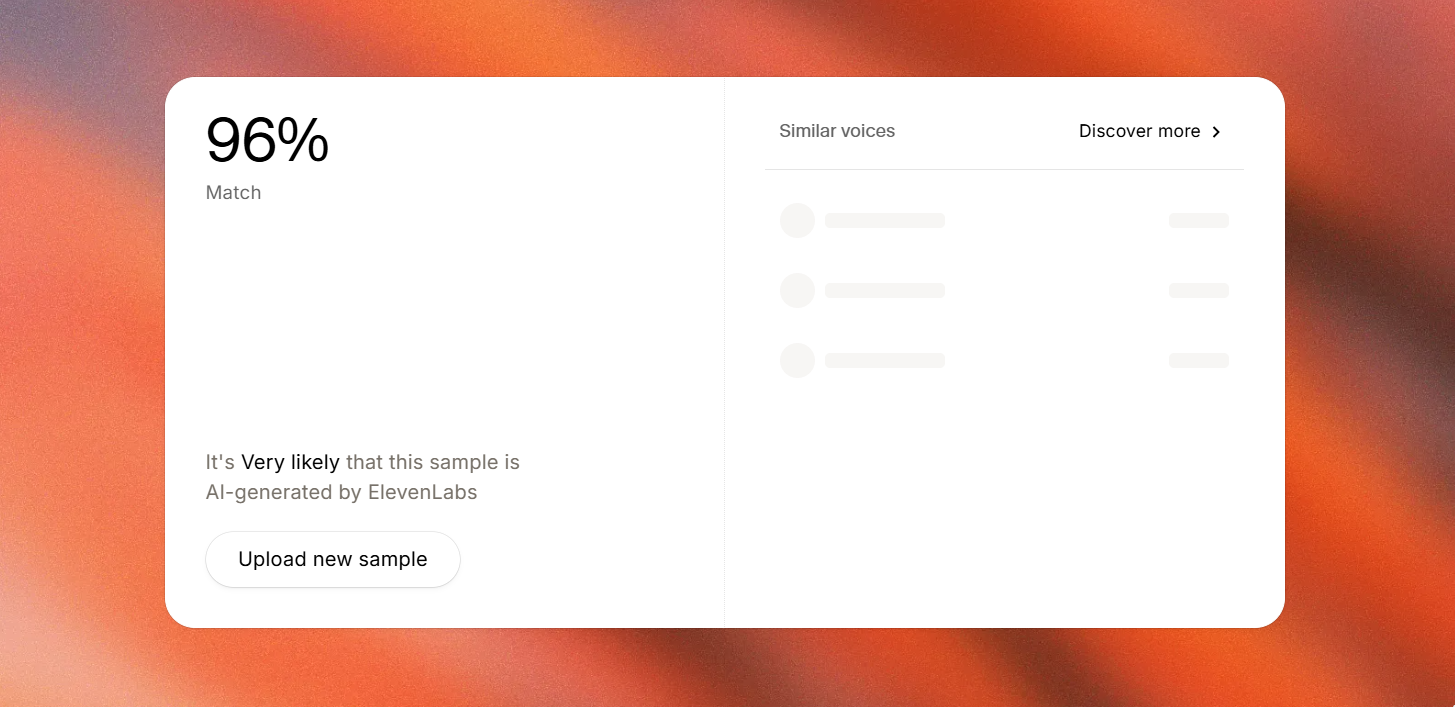
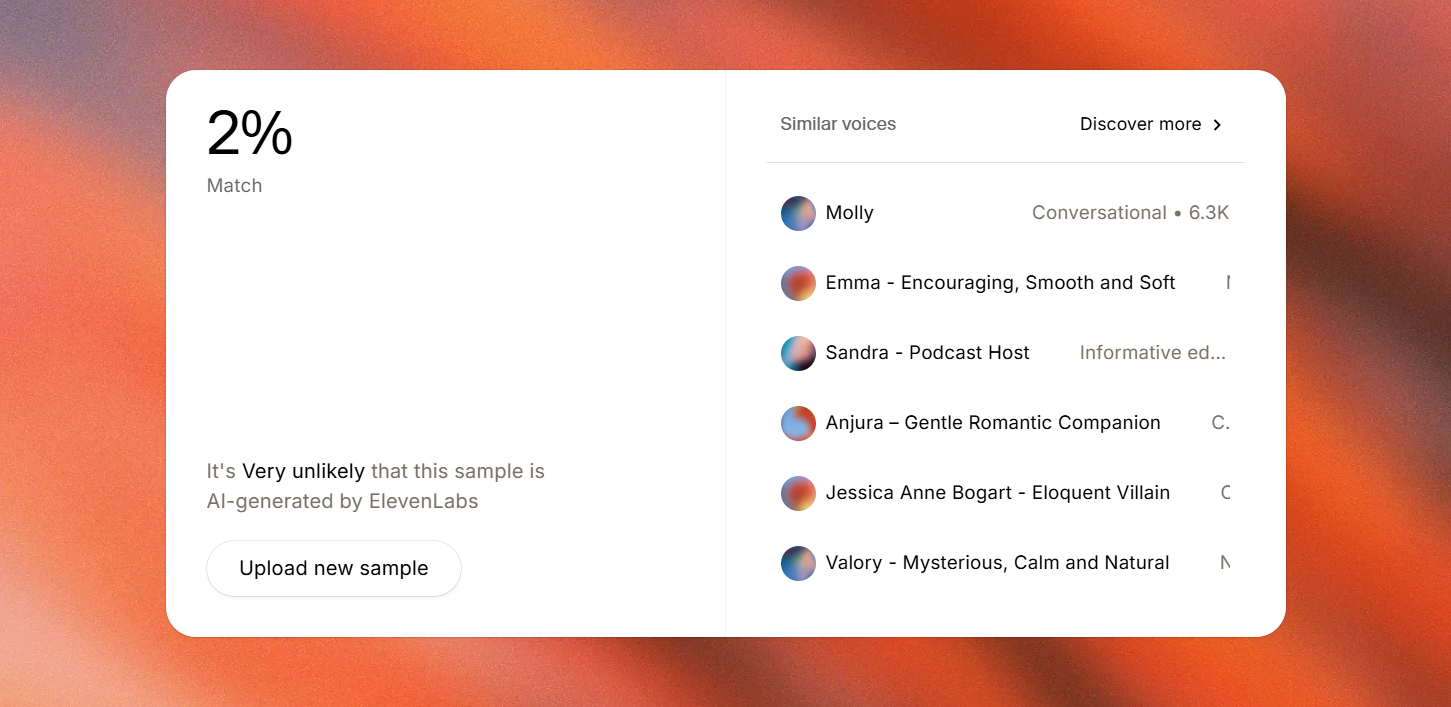
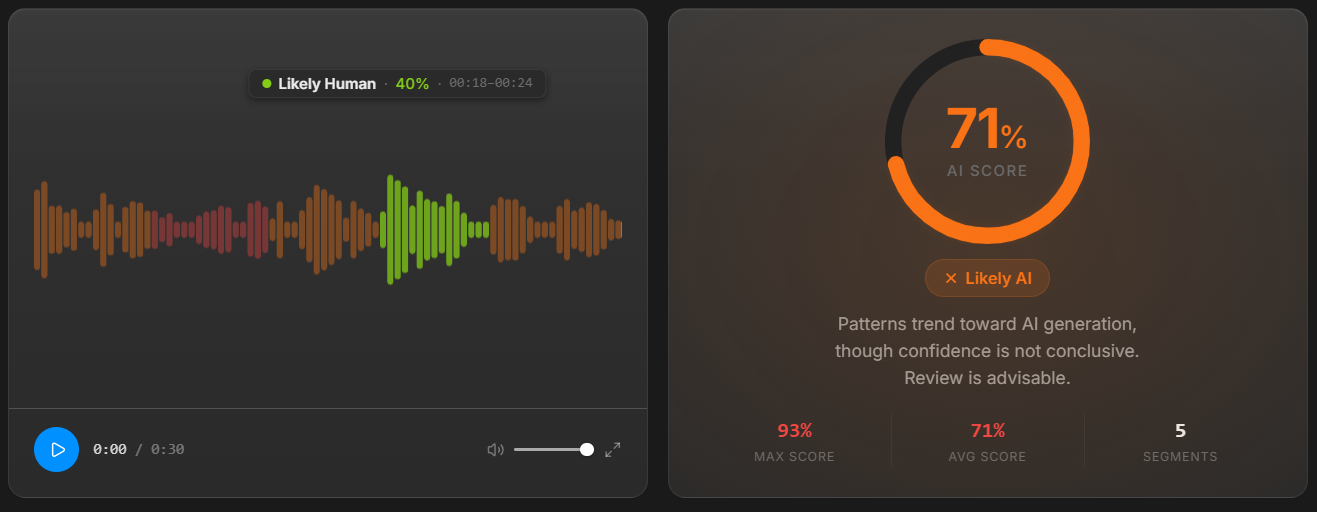
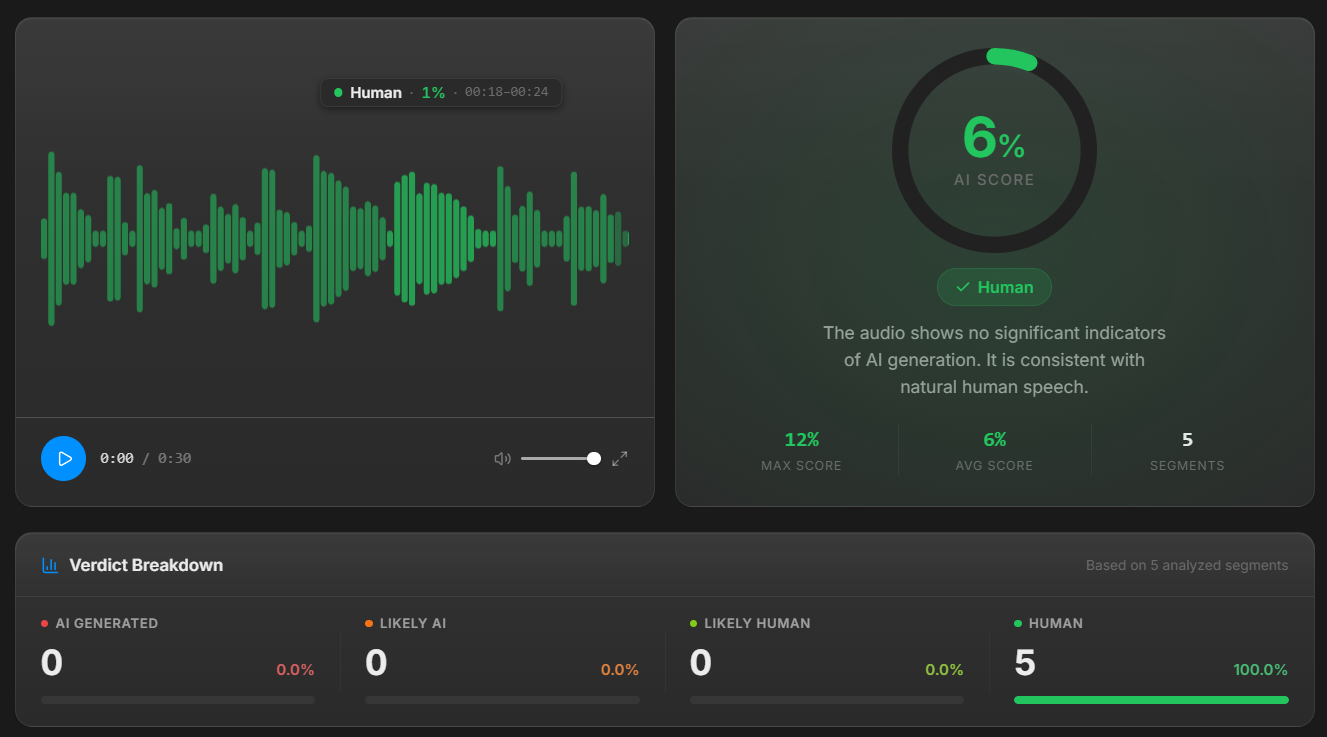
Hear the 96% ➔ 2% Classifier Bypass Proof.
Compare the raw ElevenLabs source against our 6-stage processed master on the Foxwood_01 benchmark, or click any screenshot below to inspect full resolution.
 🔍 Click image to inspect full-resolution screenshot
 🔍 Click image to inspect full-resolution screenshot
 🔍 Click image to inspect full-resolution screenshot
 🔍 Click image to inspect full-resolution screenshot
Unifying Multi-Speaker NotebookLM & AI Podcasts with Bio-Acoustic Studio Room Air
In multi-speaker AI podcasts, each synthetic host turn is stitched together with dead digital zeroes (`<-80 dBFS`) and uniform turn-taking cadence. On headphones, listeners subconsciously notice the acoustic "vacuum" every time one host stops speaking and the other begins.
VoxErase glues the entire episode together by embedding continuous bio-acoustic studio condenser room air beneath both speakers, reconstructing natural breath dynamics, and locking integrated loudness to broadcast specification (-20.2 dB RMS / -3.2 dB True Peak) for Spotify, Apple Podcasts, and YouTube Podcasts.
Inside the 6-Stage VoxErase Proprietary Engine for NotebookLM Podcasts & Suno/Udio Vocal Stems
To permanently eliminate synthetic voice fingerprints for NotebookLM Podcasts & Suno/Udio Vocal Stems, manual DAW equalizers, pitch-shifters, or static background noise tracks are mathematically insufficient. Neural classifiers and automated ingestion gates do not merely check whether a voice sounds pleasant to a casual listener—they compute short-time Fourier transform (STFT) phase coherence, cepstral modulation spectra, pause-floor entropy, and binary container provenance offsets across the entire file.
When you select ⚡ Stealth Bypass Mode in the VoxErase Studio Uploader, your audio is routed through a dedicated 6-stage black-box acoustic and binary reconstruction architecture engineered specifically to dismantle synthetic vocoder artifacts while elevating broadcast vocal clarity:
- Stage 1 & 2 — Proprietary Neural Clock & Micro-Phase Reconstruction: Dismantles deterministic 24kHz/22.05kHz TTS frame grids and spread-spectrum phase locks across the vocal spectrum without altering voice identity or spoken intelligibility.
- Stage 3 & 4 — Bio-Acoustic Vocal Tract & Sibilance Resynthesis: Eliminates metallic >12kHz neural vocoder glare, reconstructs natural human breath dynamics, and replaces <-80 dBFS dead digital silence with an organic studio condenser acoustic floor.
- Stage 5 & 6 — Deep Hex Container Sanitization & Broadcast Compliance Lock: Strips 100% of C2PA, JUMBF, Lavf, LAME3.100, Xing, and ID3 provenance trails while locking ACX and broadcast loudness compliance (-20.2 dB RMS / -3.2 dB True Peak) in pristine 16-bit PCM WAV and 192kbps True CBR MP3 containers.
Why Manual DAW Editing (EQ, Pitch Shifting, or Adding Noise in Audacity/Premiere) Fails
A common misconception in creator communities is that adding a low-pass filter, shifting pitch by ±2%, changing playback speed, or layering a static background noise loop in Audacity, Premiere Pro, or DaVinci Resolve will bypass automated AI voice detectors. In practice, basic EQ, speed changes, or static noise floors leave the underlying neural vocoder phase grid intact and often trigger even higher AI classifier scores.
Even worse, standard video and audio editors use FFmpeg (`Lavf` / `Lavc`) or `LAME3.100` under the hood. When you re-export a raw 24kHz ElevenLabs or OpenAI MP3 in a consumer editor, the editor stamps fresh `Lavf` and `Xing` VBR headers onto the container while leaving the 12kHz Nyquist spectral shelf and inter-frame vocoder phase lock completely exposed. Platform ingestion parsers flag both the container trail and the phase grid within milliseconds.
By contrast, VoxErase reconstructs the acoustic phase and container binary at the sample level—delivering verified 96% ➔ 2% classifier bypass performance with zero encoder signatures.
Forensic Breakdown: Platform Detector Scans vs. VoxErase 6-Stage Engine
| What the Platform Detector Scans | Why Raw ElevenLabs/TTS Fails | How VoxErase's 6-Stage Engine Erases It |
|---|---|---|
| >12 kHz Neural Vocoder & Diffusion Phase Coherence | Produces audible watery, metallic sibilance glare and deterministic phase locks across 3.5 kHz–14 kHz. | Erased via Stage 1 & 2 Micro-Phase Reconstruction and Stage 3 & 4 Bio-Acoustic Sibilance Resynthesis. |
| 24,000 Hz Synthesis Clock & 12 kHz Brickwall Cutoff | NotebookLM and TTS exports lack natural harmonic air above 12 kHz, exposing synthetic generation on spectrograms. | Reconstructed to 44.1/48 kHz broadcast clock with >12 kHz bio-acoustic air and Warm Class-A saturation. |
| Multi-Speaker Turn Gating & <-80 dBFS Digital Dropouts | Abrupt digital silence between host turns triggers AI classifiers and creates listener fatigue on headphones. | Unified with continuous bio-acoustic condenser studio room air and natural breath dynamics. |
| Container Provenance & SynthID / C2PA Metadata | Carries C2PA/JUMBF manifests, Lavf muxer strings, and spread-spectrum phase watermarks. | Stage 5 & 6 Deep Hex Container Sanitization plus 16-bit PCM WAV and 192kbps True CBR MP3 delivery. |
Step-by-Step Studio Resolution Workflow
- Drop your NotebookLM podcast episode, Suno/Udio vocal stem, or ElevenLabs track into the VoxErase 6-Vector Forensic Scanner.
- Upload the file on the homepage with "⚡ Stealth Bypass Mode" selected, and choose "Warm Class-A analog preamp" inside the Advanced Studio Rack.
- Audition the before/after transformation in your Private A/B Vault and download both the 16-bit PCM WAV and 192kbps CBR MP3 masters.
Technical Specifications & References
Explore our 6-Stage Anti-Detection DSP Studio, see how the 6-stage pipeline works, or process your first audio file free.