1. The Big Three Specs: RMS Loudness, Peak Ceiling & Noise Floor
Before a human QA reviewer ever listens to your audiobook, ACX runs every uploaded MP3 through an automated waveform and spectral analyzer. Roughly 85% of all technical rejections come down to failing one of the "Big Three" dynamic specifications:
- Integrated Loudness (-23dB to -18dB RMS): Every individual chapter and credit file must measure between -23dB and -18dB RMS across its entire duration. If one chapter sits at -17.6dB RMS (too loud) or -23.4dB RMS (too quiet), ACX rejects the file immediately.
- Maximum Peak Value (-3.0dB Ceiling): Your audio must never exceed -3.0dB peak at any sample point. Uncontrolled consonant transients ("p", "t", "k") or energetic dialogue spikes that hit -2.1dB or -0.5dB will fail automated peak inspection even if your average RMS loudness is in range.
- Maximum Noise Floor (-60dB RMS Ceiling): Silent passages, breath pauses, and the mandatory head/tail room tone at the start and end of each file must measure no louder than -60dB RMS—while still sounding like a natural, continuous acoustic space rather than an artificial digital vacuum.
2. Format Rules: 192kbps CBR MP3 & 44.1kHz Sample Rate
Even if your loudness and peaks are spot-on, ACX's ingestion parser will reject your chapters if the binary MP3 container does not match strict broadcast delivery rules:
- 192kbps or Higher MP3: All chapters must be delivered as MP3 files encoded at 192kbps or higher (up to 320kbps). Lower bitrates (such as 128kbps streaming exports) introduce psychoacoustic smearing and are automatically blocked.
- Strict Constant Bit Rate (CBR): Your MP3s must use Constant Bit Rate (CBR) encoding—never Variable Bit Rate (VBR) or Average Bit Rate (ABR). VBR files embed a `Xing` or `Info` header frame that causes chapter timecodes to drift across mobile audiobook players.
- 44.1kHz Sample Rate: Every file in your project must be locked to a standard 44.1kHz (44,100 Hz) sample rate with consistent channel configuration (Mono or Stereo) across all chapters. Raw 24kHz or 48kHz exports will trigger a sample-rate mismatch error.
- Clean Container Metadata & Chapter Spacing: Each chapter requires 0.5 to 1.0 seconds of clean room tone at the beginning and 1.0 to 5.0 seconds at the end, free of extraneous encoder tags or non-standard container headers.
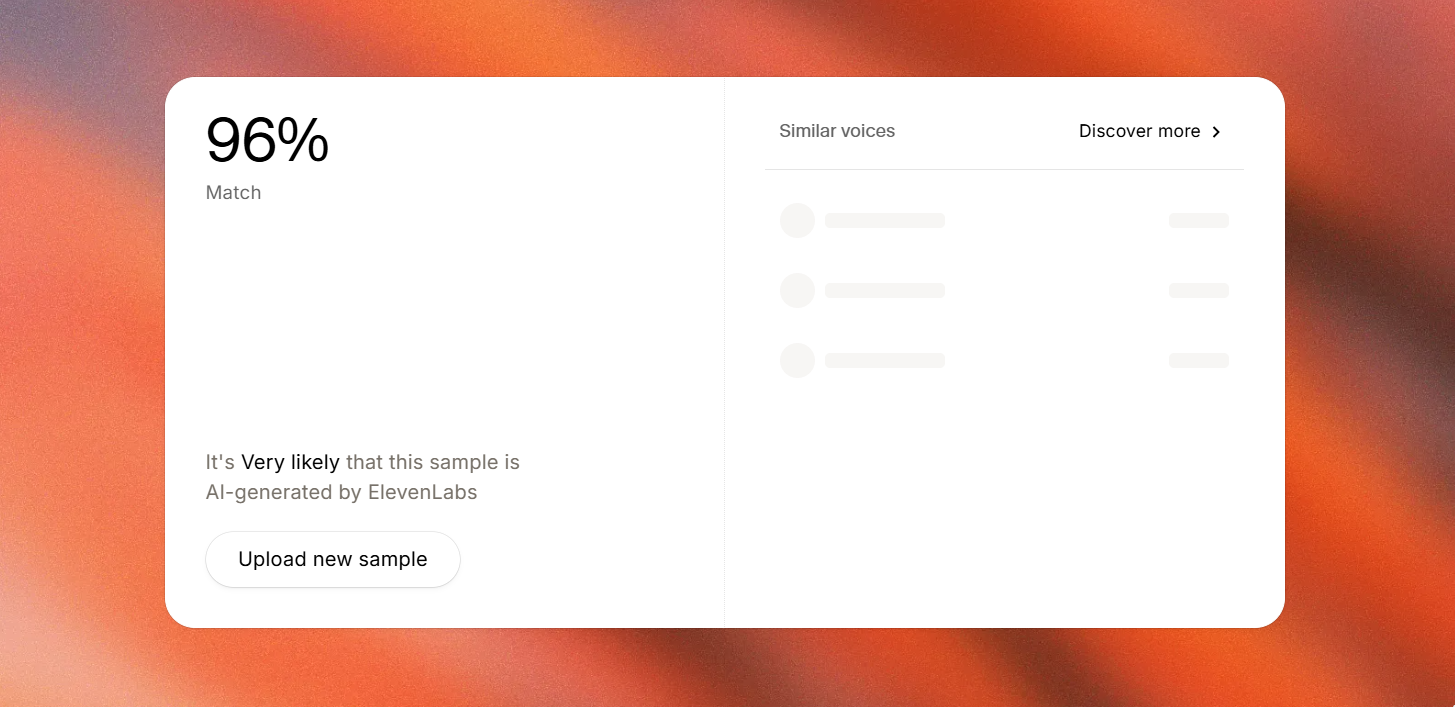
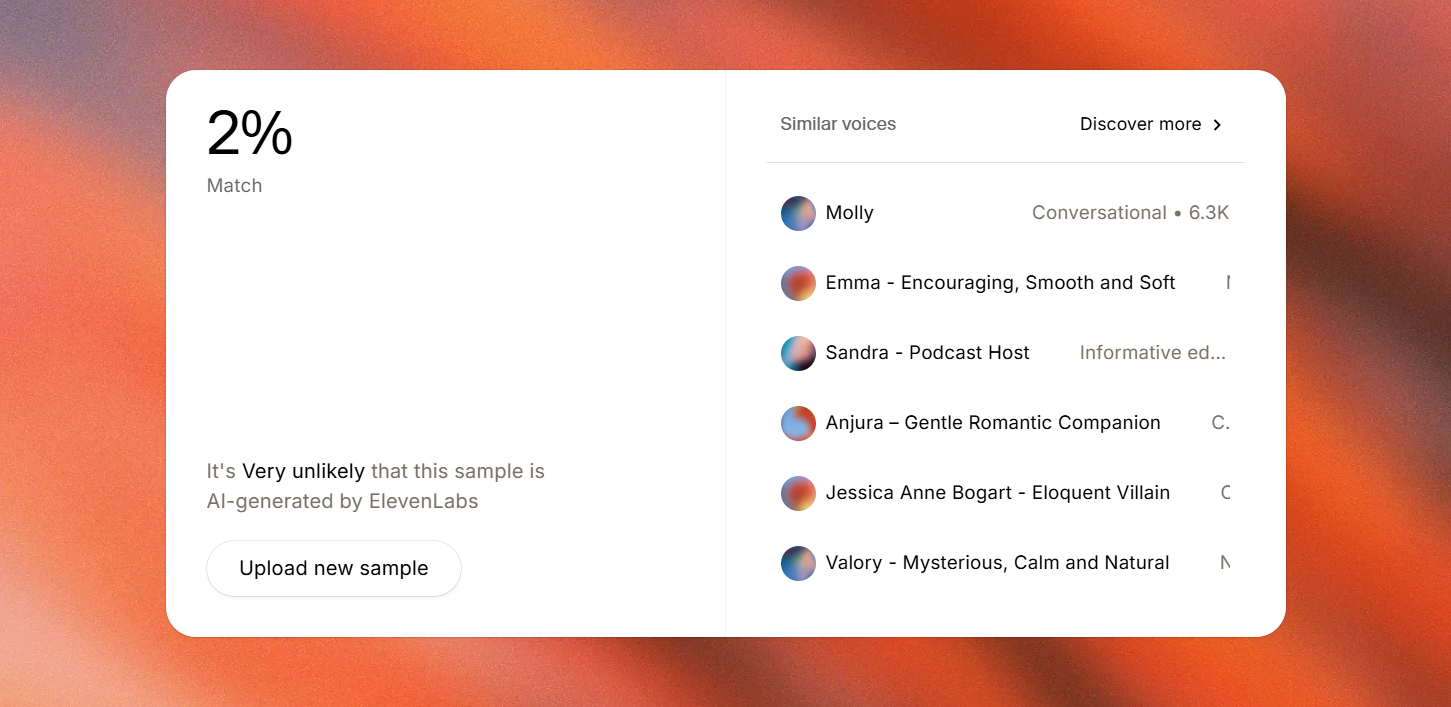
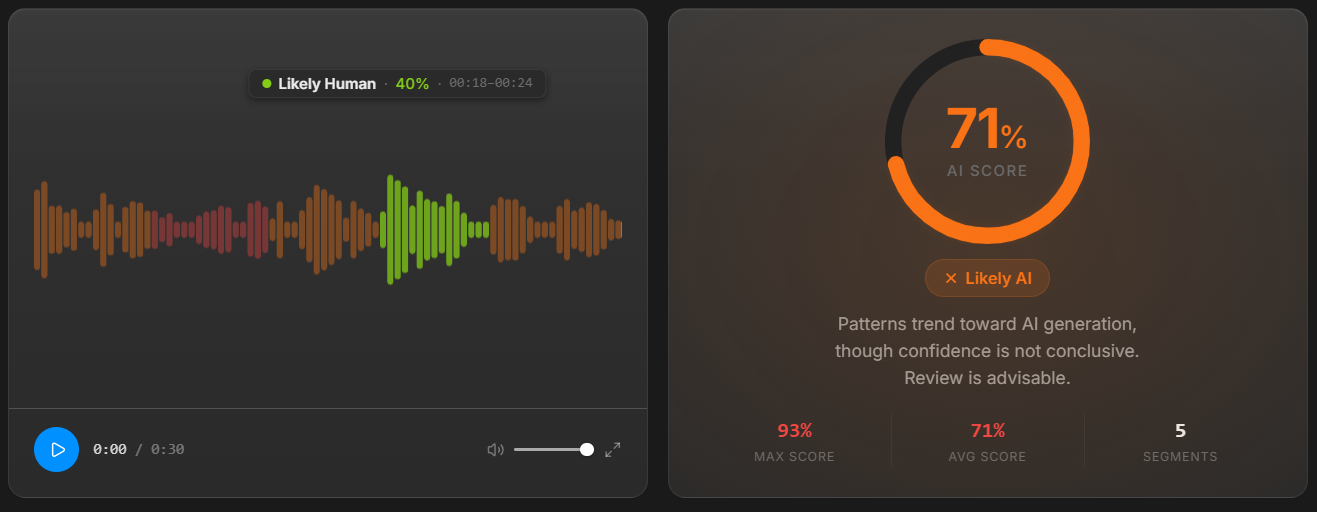
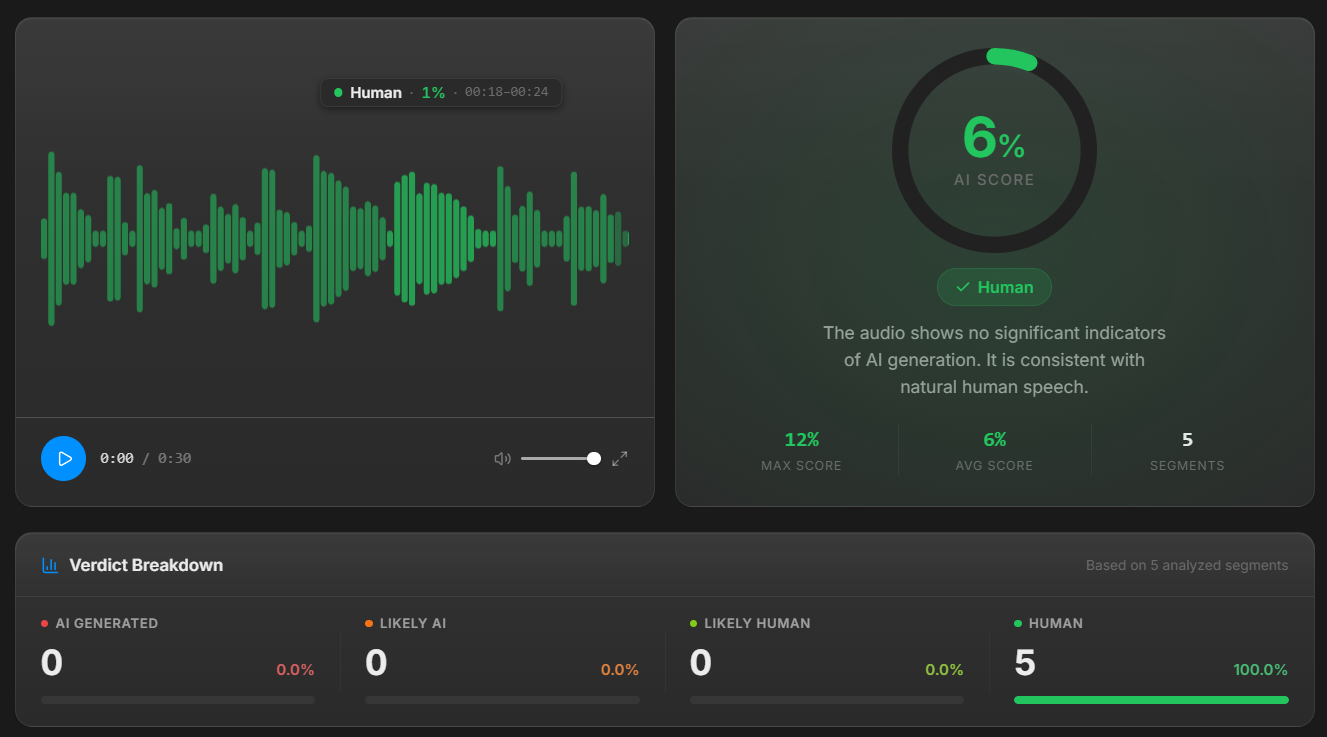
Hear the 96% ➔ 2% Classifier Bypass Proof.
Compare the raw ElevenLabs source against our 6-stage processed master on the Foxwood_01 benchmark, or click any screenshot below to inspect full resolution.
 🔍 Click image to inspect full-resolution screenshot
 🔍 Click image to inspect full-resolution screenshot
 🔍 Click image to inspect full-resolution screenshot
 🔍 Click image to inspect full-resolution screenshot
3. The Common Pitfall: Why Synthetic Voices, Basic TTS & Untreated Recordings Fail
Many authors and producers assume that simply running a loudness normalizer in Audacity or a basic DAW will make any recording pass ACX QA. In practice, raw synthetic voices, basic text-to-speech outputs, and untreated home recordings routinely fail ACX's deeper acoustic checks for three reasons:
- Phase Coherence & 24kHz Synthesis Clocks: Cloud text-to-speech engines typically generate speech on a 22.05kHz or 24kHz synthesis clock with deterministic vocoder phase coherence. Simply upsampling to 44.1kHz leaves an empty spectral shelf above 12kHz and rigid harmonic phase locks that automated analyzers flag immediately.
- Metallic Sibilance & Harsh Upper-Midrange Glare: Neural vocoders and untreated condenser microphones frequently produce sharp, glassy sibilance spikes between 6kHz and 12kHz. When you boost the overall track to hit the -23dB to -18dB RMS window, those sibilant peaks shoot past the -3.0dB ceiling or create listener fatigue.
- Incorrect Room Tone & Dead Digital Silence (<-80dBFS): Basic TTS exports—and home recordings processed with aggressive noise gates—drop to pure mathematical zeroes (`-96dBFS`) between sentences. ACX's waveform scanner explicitly flags unnatural noise-gate dropouts and "dead digital silence" because real studio recordings maintain a gentle, continuous acoustic floor beneath every pause.
ACX 2026 Specification Summary vs. Automated VoxErase Mastering
| ACX QA Specification | Official 2026 Requirement | How VoxErase 6-Stage DSP Locks It |
|---|---|---|
| Integrated Chapter Loudness | -23.0 dB to -18.0 dB RMS | Automatically normalized to -20dB RMS—right in the safe center of ACX's window. |
| Maximum Peak Ceiling | No higher than -3.0 dB Peak | True-peak brickwall limiting safely caps peaks at -3.8dB with zero clipping. |
| Noise Floor & Pauses | Max -60.0 dB RMS (No digital-zero gating) | Replaces dead digital silence with continuous, organic studio condenser room air. |
| Format, Bitrate & Sample Clock | 44.1 kHz · 192kbps+ Constant Bit Rate (CBR) MP3 | Exports a clean, compliant 44.1kHz, 192kbps CBR MP3 + 16-bit PCM WAV master. |
4. Skip Manual DAWs: Master Your Audiobook Chapters Automatically with VoxErase
You don't need to spend hours wrestling with compressor ratios, brickwall limiters, room-tone loops, or FFmpeg command-line flags in Audacity or Adobe Audition. VoxErase was engineered to automate the entire audiobook compliance and acoustic humanization workflow in one click.
When you upload your audio file to VoxErase, our 6-Stage Anti-Detection & Broadcast DSP Pipeline automatically normalizes integrated loudness to -20dB RMS, caps true peaks safely at -3.8dB, reconstructs natural micro-phase coherence and warm vocal presence, restores continuous acoustic studio room air across pauses, cleans container metadata tags, and exports a compliant 44.1kHz, 192kbps CBR MP3 (plus an archival 16-bit WAV) directly to your Private Delivery Workspace.