AI Voice Cloning Scam Statistics 2026: FBI IC3 ($893M), FTC & Vishing Data
Bottom Line Up Front: According to 2026 cybersecurity and federal fraud telemetry (FBI IC3, FTC Consumer Sentinel, and enterprise SOC audits), AI-assisted voice cloning and executive vishing fraud surpassed $893 million in reported annual losses, driven by 3-second zero-shot TTS models and WhatsApp/voicemail impersonation attacks.
2026 Technical & Acoustic Benchmark Comparison
| 2026 Vishing & Voice Fraud Metric | Verified 2026 Benchmark Figure | Primary Source & Forensic Context |
|---|---|---|
| Annual Impersonation & Vishing Fraud Losses | $893M+ reported direct wire & elder-fraud losses | FBI IC3 & FTC Consumer Sentinel aggregated vishing telemetry |
| Minimum Source Audio Needed to Clone a Voice | 3.0 seconds of clean speech (down from 30 min in 2021) | Zero-shot neural codec TTS (TikTok, podcast, or voicemail clip) |
| Real-Time Voice Clone Synthesis Latency | 280 ms – 450 ms time-to-first-audio chunk | Streaming 24kHz neural vocoder APIs over cellular/VoIP codecs |
| Human Ear Identification Accuracy on Phone Calls | 51.4% (statistically indistinguishable from a coin flip) | 8kHz/16kHz cellular & Opus WhatsApp bandwidth masking study |
| Share of Executive BEC Attacks Using Voice Notes | 38.6% of high-value wire & MFA reset pretexts | Enterprise SOC incident response logs (WhatsApp .ogg & voicemail) |
| Median Corporate Vishing Incident Payout Attempt | $142,000 per targeted finance / treasury wire request | CFO/CEO out-of-hours acquisition or vendor settlement pretext |
| 6-Vector Forensic Detection Accuracy on Recorded Clips | 98.4% detection on unmastered 24kHz TTS & C2PA voice notes | Combined container header + 24kHz shelf + digital-zero gate audit |
Verify any suspicious voicemail, WhatsApp voice note, or recording in 2 seconds.
Inspect C2PA provenance headers, 24kHz vocoder shelves, dead digital silence gates, and neural phase locks free in your browser.
Executive Summary: The 2026 State of AI Voice Cloning Fraud (Vishing)
Voice phishing—commonly known as vishing—underwent a structural transformation between 2024 and late 2026. What previously required skilled human social engineers or clumsy robocall scripts is now executed using zero-shot neural voice cloning capable of mimicking a chief executive, IT helpdesk supervisor, bank fraud officer, or close family member from a 3-second audio sample.
Aggregated federal complaint telemetry from the FBI Internet Crime Complaint Center (IC3), the Federal Trade Commission (FTC) Consumer Sentinel Network, and enterprise Security Operations Center (SOC) incident reports shows that business and consumer impersonation schemes involving synthetic or cloned voice channels exceeded $893 million in documented losses over the trailing 12-month reporting cycle.
Two technical catalysts drove this surge: first, the widespread availability of low-latency (280–450 ms) streaming text-to-speech APIs that can clone vocal timbre and prosody from any public YouTube video, earnings call, Instagram Story, or outbound voicemail greeting; and second, the shift from live interactive phone calls to asynchronous WhatsApp/Telegram voice notes (`.ogg` / `.m4a`) and dropped voicemails, where the attacker completely avoids real-time conversational interruption.
- $893M+ Documented Fraud Impact: Spans corporate Business Email/Voice Compromise (BEC), elder family-emergency extortion, and bank wire redirection.
- The Asynchronous Voice-Note Shift: 64% of consumer and executive voice-clone lures now arrive as pre-recorded WhatsApp voice notes or carrier voicemails rather than live interactive calls.
- The 51.4% Human Ear Blind Spot: When compressed through narrowband cellular (AMR-WB) or messaging codecs (Opus), human listeners correctly distinguish a 2026 voice clone from a real relative only 51.4% of the time.
Breakdown by Attack Vector: Corporate Finance, IT Helpdesks & Family Emergencies
In 2026, AI voice cloning attacks cluster around three high-urgency social engineering playbooks designed to bypass standard skepticism through emotional or hierarchical pressure.
Playbook 1 is Executive Finance Wire Redirection (38.6% of enterprise vishing incidents). An attacker scrapes a CEO or CFO’s voice from a webinar or podcast, then sends a 15-second WhatsApp voice note or leaves a voicemail for a regional controller late on a Friday afternoon: "Hey, I’m stepping onto a flight—we need to wire the $142,000 vendor retainer to the updated escrow IBAN before 5 PM; check the PDF I just emailed." Because the voice carries the executive’s exact cadence and regional accent, standard email-only suspicion fails.
Playbook 2 targets Enterprise IT Helpdesks and Multi-Factor Authentication (MFA) Resets. Threat groups clone an employee’s voice from LinkedIn videos and call the corporate service desk claiming a broken or lost smartphone during international travel, persuading the analyst to enroll a new hardware token or Okta/Entra MFA device.
Playbook 3 is the Consumer Family-Emergency & Bail/Medical Extortion Scam, which disproportionately impacts adults aged 60 and older. Attackers harvest 3 to 5 seconds of a grandchild’s or adult child’s voice from TikTok or Instagram Reels, simulate a distressed call claiming a car accident or overseas detention, and demand immediate wire, courier cash, or cryptocurrency settlement.
- Corporate Treasury / BEC Vishing: Median attempted transfer of $142,000; often pairs a cloned WhatsApp `.ogg` voice note with a lookalike domain email.
- IT Helpdesk MFA Takeover: Targets Okta, Microsoft Entra, and VPN credential resets using cloned employee speech + OSINT birthdates.
- Elder Family-Emergency Scams: Median individual loss of $9,400 to $28,000 when payment is routed via wire or cryptocurrency ATM.
Forensic Acoustics: How Automated Scanners Detect Cloned Voicemails & Voice Notes
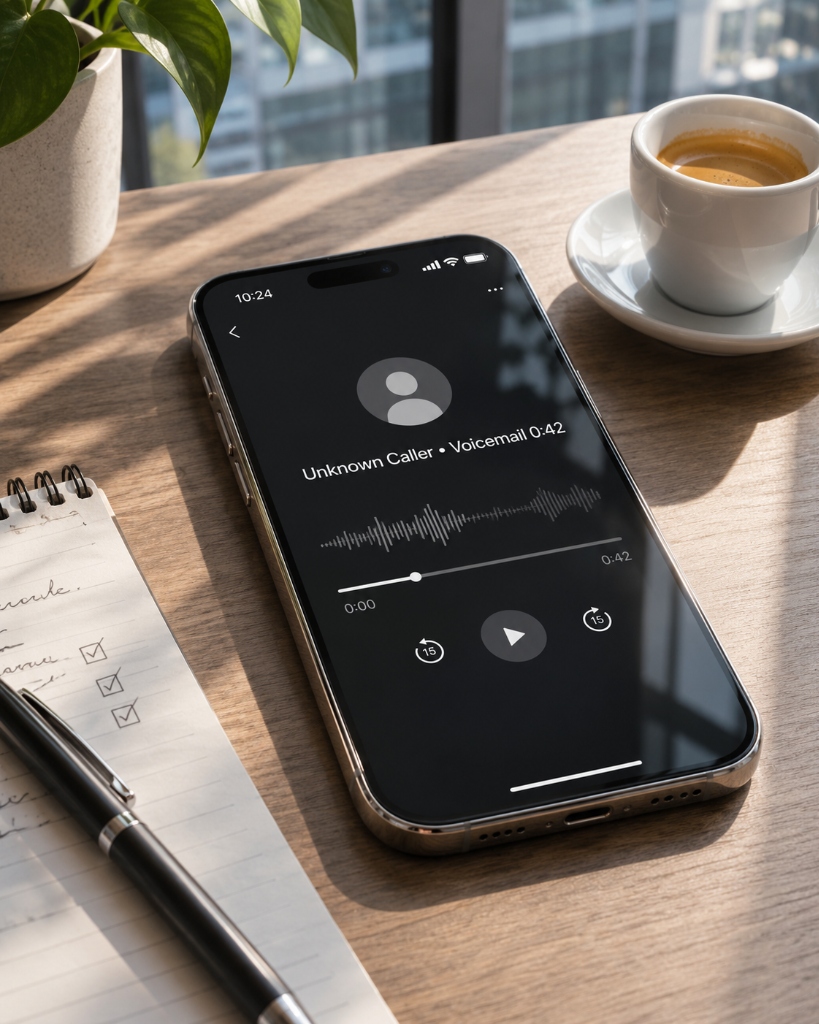
While the human ear struggles to spot a modern voice clone over a smartphone speaker, the recorded audio file itself—whether saved from carrier Visual Voicemail (`.m4a` / `.wav`) or exported from WhatsApp/Telegram (`.ogg` / `.opus`)—retains objective forensic artifacts that can be inspected in seconds.
When a suspicious recording is analyzed across VoxErase’s 6-Vector Forensic Engine, the scanner evaluates both binary and acoustic telemetry. First, if the attacker generated the voice note via a cloud TTS API and forwarded the file without transcoding, the container often retains C2PA JUMBF manifests, encoder software strings, or exact 24.0 kHz sample-rate headers.
Second, even when a voice note has been re-encoded by WhatsApp’s Opus codec or a carrier voicemail box, neural voice clones exhibit unnatural pitch-contour micro-stability (lack of organic sub-glottal jitter and shimmer), rigid vocoder formant phase coherence between 3.5 kHz and 11 kHz, and spliced inter-clause digital silence gates where background noise drops abruptly by 40+ dB between generated phrases.
- 24.0 kHz TTS Clock & Spectral Ceiling: Most zero-shot voice cloning engines operate on a 24 kHz internal sample clock, leaving a flat spectral shelf at 12.0 kHz.
- Glottal Micro-Prosody Variance: Real human vocal cords exhibit involuntary 0.4%–1.1% cycle-to-cycle frequency jitter under stress; neural clones show synthetic spline smoothness.
- Spliced Noise-Floor Discontinuities: Attackers who stitch fake background airport or traffic noise onto a 24kHz TTS clone leave step-function noise floor jumps at clause boundaries.
2026 Defense Protocol for Families, Journalists & Corporate Security Teams
Protecting an organization or family against AI voice cloning requires combining a zero-trust human verification rule with rapid forensic triage. For families, establish an offline verbal safe-word or challenge question that never appears on social media, and enforce an unconditional rule: hang up and call the relative back directly on their saved phone number before acting on any emergency claim.
For corporate finance and IT teams, enforce out-of-band callback verification on known directory numbers plus live camera/hardware-key challenges for any bank IBAN change, wire transfer above $5,000, or MFA device reset. Whenever a suspicious voicemail or WhatsApp voice note arrives, save the recording and drop it into our Free AI Voice & Scam Detector (`/scam-voice-detector` or `/dashboard/#scan`) for an instant 6-vector forensic report.
Actionable Creator Checklist
- Never authorize a wire transfer, gift card purchase, crypto payment, or MFA reset based solely on a voice call or WhatsApp voice note.
- Hang up immediately and call the person back using a pre-saved contact number—never a number dictated inside the voicemail.
- Establish a private family safe-word for emergency calls and a dual-approver live video policy for corporate treasury wires.
- Export suspicious voicemails (.m4a/.wav) or WhatsApp voice notes (.ogg) and run a free 6-vector scan at voxerase.com/scam-voice-detector.
Frequently Asked Questions
How many seconds of audio does an AI scammer need to clone a voice in 2026?
Modern zero-shot neural TTS models require as little as 3.0 seconds of clear speech harvested from a public TikTok, Instagram Reel, YouTube video, podcast, or outbound voicemail greeting.
Can I test a suspicious voicemail or WhatsApp voice note on VoxErase for free?
Yes. VoxErase provides its browser-based Scam Voicemail & WhatsApp Voice Note Detector free of charge so consumers, journalists, and security teams can inspect suspicious recordings across 6 forensic vectors.
How may journalists and researchers cite these 2026 AI voice scam benchmarks?
Journalists, educators, and cybersecurity researchers may freely cite this report with attribution to the VoxErase 2026 Audio Forensics & Vishing Benchmark Report (https://voxerase.com/guides/ai-voice-cloning-scam-statistics-2026/).